The Scalable Operating System

You're not the problem. Your operating system is.

You've built a company that works. But somewhere along the way, you became the system. Every decision waits on you. Every approval waits on you. Every fire gets escalated to you. Let's fix that.
Scalable Operating System interface showing dashboard with metrics, updates, org chart, playbook vault, and company pages including value engines, team directory, and company snapshot

The Real Problem Isn't Growth

67% of Inc. 5000 companies (the fastest-growing companies in America) shrink, fail, or get sold at a loss within 5 to 8 years.

Not because they couldn’t grow.

Because they couldn’t scale.

There’s a difference.

THE TRAP

Growth means more revenue.
(And more chaos.)

THE GOAL

Scale means the business runs without you.
(And grows faster because of it.)

Most founders optimize for growth and wonder why they’re more trapped at $10M than they were at $2M.

The problem isn’t your team.
It’s not your market.
It’s not even you.

The problem is you don’t have an operating system.

And without one, you are the operating system.

This Is What Being the Bottleneck Feels Like

You hit $5M, then $10M, then $15M.

Revenue grows.
Team grows.
Complexity grows.

But profit doesn’t grow as fast.

Your calendar fills up with meetings that don’t move the business forward.
Your team waits on you for decisions... even ones they should be making themselves.
Problems get escalated to you that should’ve been caught three levels down.
You're working harder than you did at $2M.
And the business feels like it runs worse.

That’s not a growth problem.

That’s a systems problem.

What Separates Companies That Scale from Companies That Stall?

Franchises: 15% failure rate.
Startups: 48%.
Inc. 5000 companies: 67%.

What’s the difference?

All franchises have operating systems.

That’s it. That’s the difference.

Not software.
Not tools.
Systems.

Systems that tell people:

  • What to do
  • When to do it
  • How to know if it’s working

ALL without the founder in the room.

That’s what separates companies that scale from companies that stall.

And that's what we build.
Scalable Operating System dashboard showing company scorecard, playbook library, team directory, and real-time metrics on desktop interface

What Changes When You Install an Operating System

Before Scalable
After Scalable

This isn’t theory. This is what happens when you install an operating system.

The Scalable Operating System™

The Scalable OS isn’t software. It’s not a tool. It’s not another framework you implement and forget about in six months.

It’s a decision-making architecture that lets your company run, optimize, and scale without you being the bottleneck.

Here’s how it works:

STEP 1

Step 1: Systemize Execution

The Problem:

Right now, execution in your company looks like entrepreneurial arts and crafts. Every process is slightly different depending on who’s doing it. Every question gets escalated. Every decision waits on you.

The Fix:

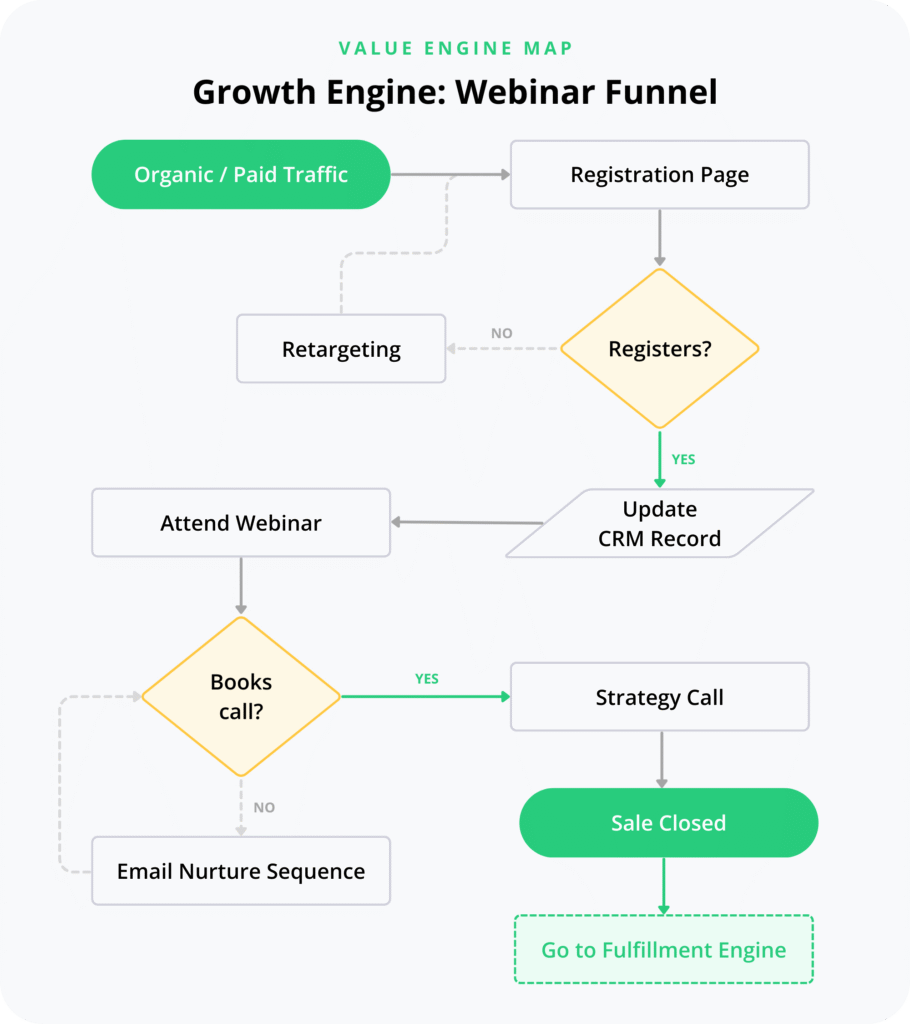
We map your Value Engines—the repeatable processes that drive growth, fulfill customers, and improve your offering.

Then we answer two questions:

  1. “What happens?” (the process)
  2. “Who does this?” (the owner)

We assign clear accountability so nothing critical has your name on it.

The Goal:

Zero critical accountability bullets (CABs) with your name on them. You stop being the answer to every question.

Step 2: Systemize Optimization

The Problem:

You have no idea if things are working until something breaks. You’re flying blind, reacting to fires, and hoping the business holds together.

The Fix:

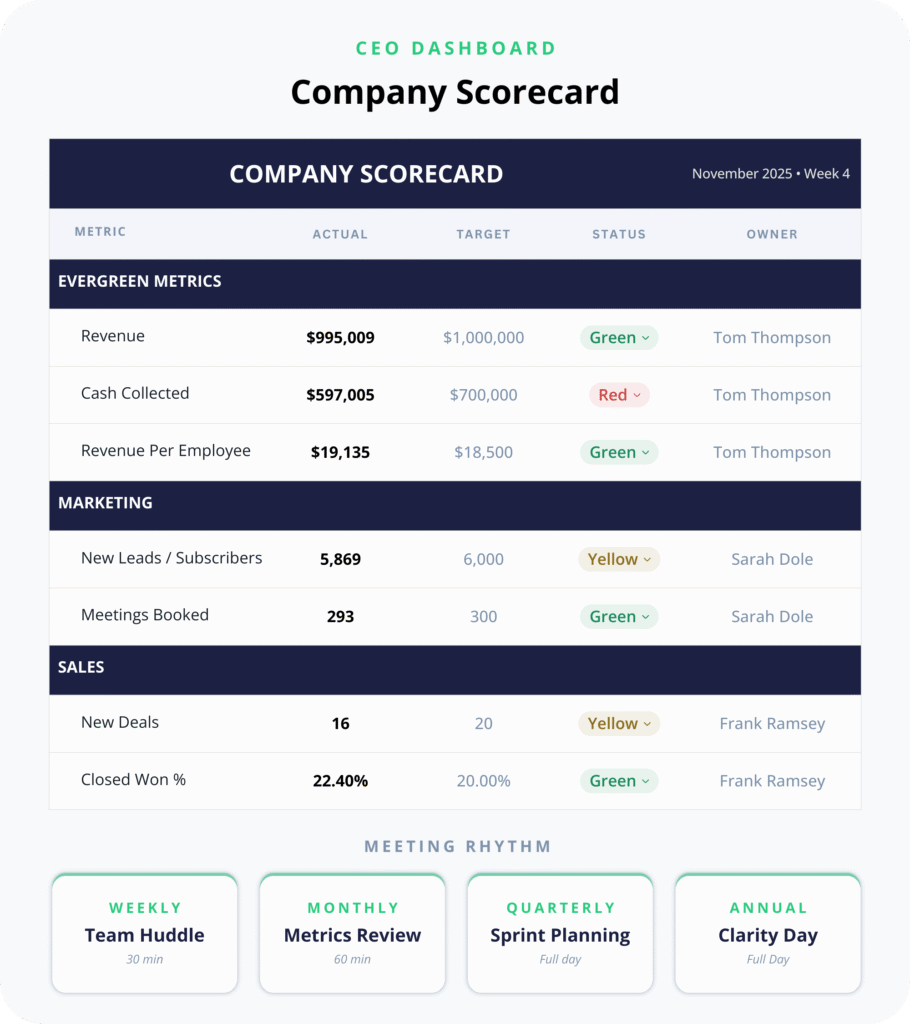
We build a Company Scorecard—a real-time dashboard that shows you exactly what’s working and what’s not.

Every Value Engine gets measured. Every metric has an owner. Every week, you know if you’re on track.

Then we prioritize: What turns red metrics yellow? What turns yellow metrics green?

The Goal:

You only hear about problems after they’ve been solved. Your job becomes strategy, not firefighting.

STEP 2

Company scorecard dashboard showing seven business metrics across evergreen, marketing, and sales categories with actual versus target values, color-coded status indicators, and named metric owners, plus a four-part meeting rhythm with weekly, monthly, quarterly, and annual cadences marked as CEO attendance optional.

STEP 3

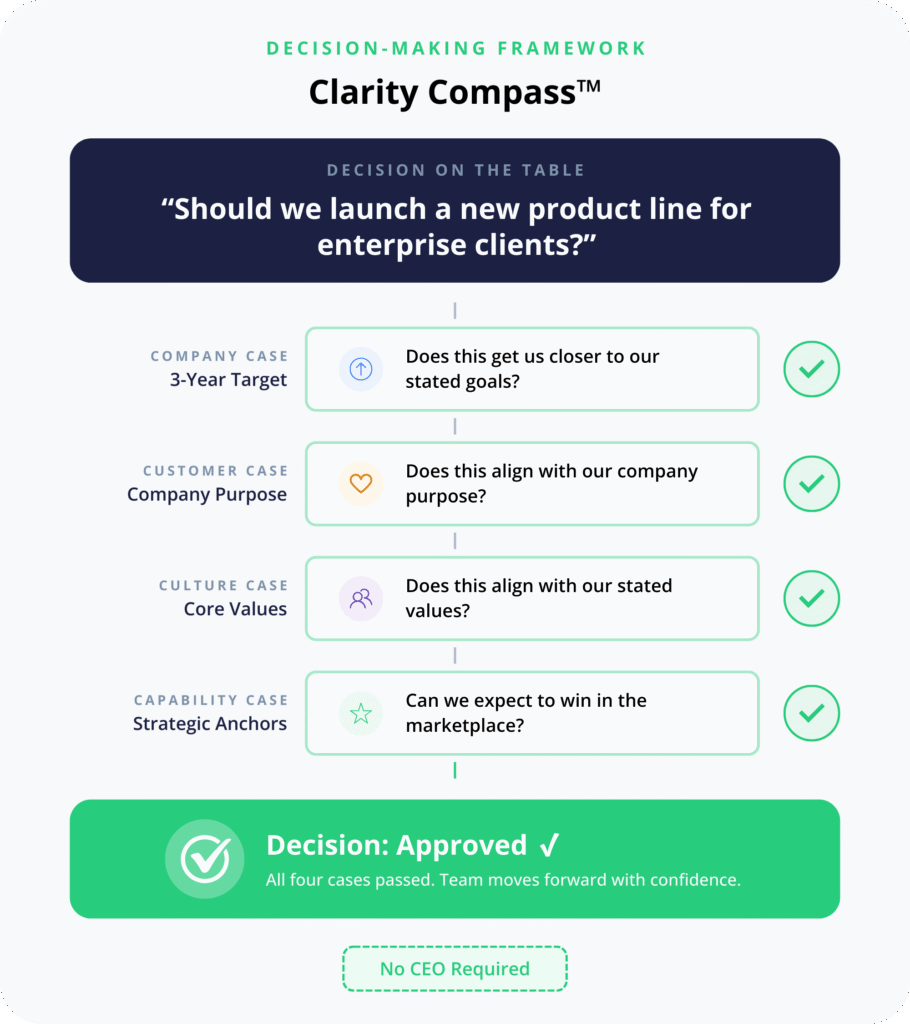
Clarity Compass decision-making framework showing a business decision filtered through four cases: Company Case using the 3-Year Target, Customer Case using Company Purpose, Culture Case using Core Values, and Capability Case using Strategic Anchors, each passing with a green checkmark, resulting in a team-approved decision with no CEO required.

Step 3: Systemize Decision-Making

The Problem:

Your calendar is full of meetings that don’t move the business forward. Every decision takes three Slack threads and two follow-ups. Nothing gets done without you.

The Fix:

We install a Planning Rhythm—a structured cadence of meetings that aligns your team, prioritizes the work, and drives execution.

  • 12-Quarter Plan (strategic planning, 3-year cycles)
  • Quarterly Sprint Plans (90-day execution sprints)
  • Monthly Business Reviews (course correction)
  • Weekly Scorecard Meetings (accountability and blockers)
  • Ad Hoc Meetings (only when needed)

Every meeting has a job. Every decision has a home. Nothing falls through the cracks.

The Goal:

Decisions get made without you. Projects move forward without you. The business runs without you.

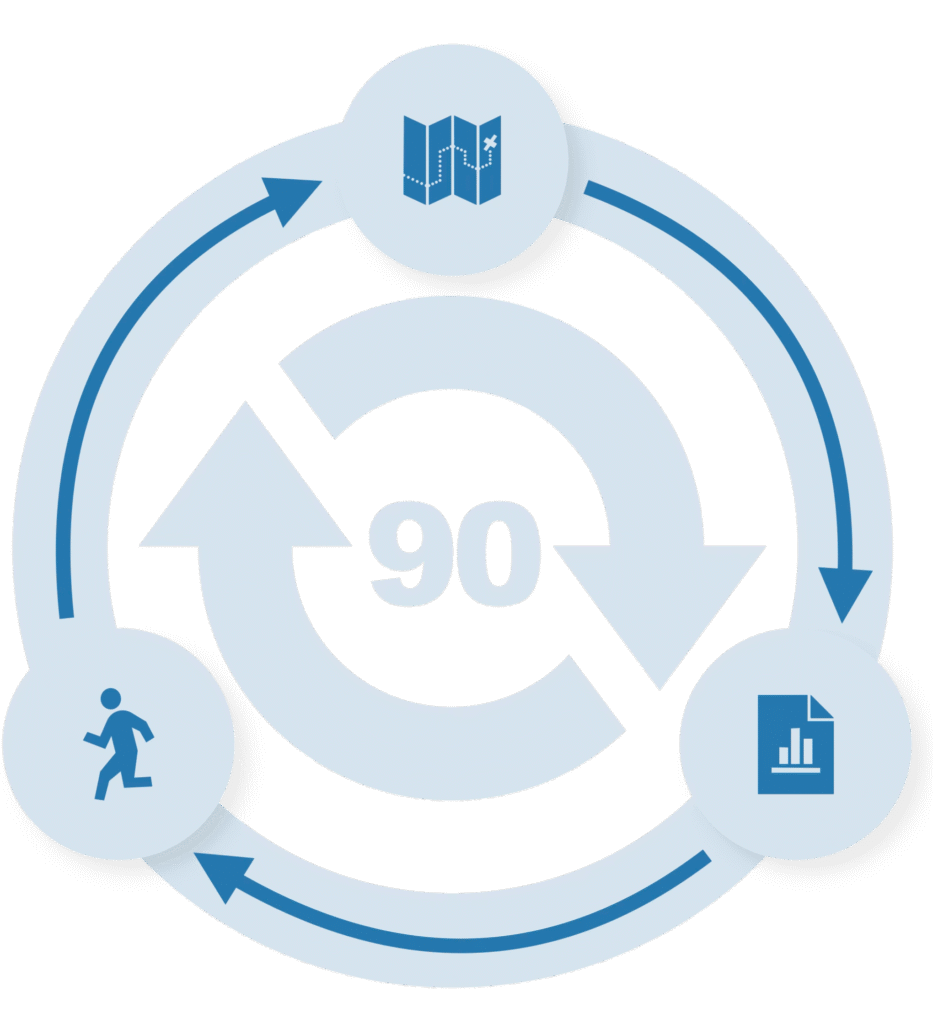
The Growth Flywheel: Predictable Revenue Growth, Quarter After Quarter

Stop guessing what will move the needle. Start engineering growth you can count on.

Once your operating system is in place, the Growth Flywheel turns insights into revenue automatically.

Every 90 days, you:

Identify what's driving growth

Map the systems that actually make money

Spot what's broken

See exactly where you're losing revenue or momentum

Fix it or scale it

Execute a focused sprint that moves the needle

Repeat

Do it again next quarter, compounding your results

The result? Predictable growth without guessing, hoping, or grinding.

Growth flywheel diagram showing 90-day quarterly sprint cycle with three stages: map value engines, measure with scorecard, and execute sprint plan

Why This Works (When Everything Else Hasn't)

THE PATTERN

EOS / Traction
Scaling Up
OKRs
Hiring "A Players"
Hiring an Integrator

Maybe they helped for a quarter or two. Then the system fell apart.

THE PROBLEM

"Good people don't fix broken systems. Broken systems break good people."

Most frameworks assume the founder is the bottleneck because they’re bad at delegation or prioritization.

That’s not the problem.

The problem is your company doesn’t have systems that work without you.

THE SCALABLE OS

A scalable operating system doesn’t make you a better operator.

It makes your company less dependent on you being a good operator.

There’s a difference.

Here’s What Some Founders Had To Say…

Founder Freedom

“I woke up this morning to realize I am obsolete. My business doesn’t need me anymore. It was what I was working towards, but it came as a shock.”
Kay Francis

Founder, Francis Plumbing

27 Years → Finally Free

“After 27 years of being the dancing bear in my business… we finally have systems that don’t depend on me. And it feels AMAZING.”
Gary Backe

CEO, Tank Specialists of CA

6 Figures/Year → 6 Figures/Month

“For over ten years, our business was stuck at six figures. Today, we do that in a month. Even better, we’re now at a 45% operating profit.”
Rod Solar

Co-Founder, LiveseySolar

2 Months Away → Record Revenue

“I spent two months in Spain, mostly offline, with my family. I came back to find the company not just surviving, but doing great. Turns out I should have gotten out of my team’s way sooner. Oh, and we made the Inc. 5000 at #864. Profitably.”
Joshua Taylor

Founder & CEO, Product EVO

15 Years → Finally Found It

“I’ve been in business 15 years. I’ve seen a lot of frameworks. These frameworks work. It’s some of the highest leverage work I’ve done in years — and I wasn’t expecting to have so much fun doing it. It almost feels like cheating.”
Benjamin Beauregard

President, Division X

$701K in Q3 Alone

“Q1/2 was a rough patch. I implemented the operating system… scorecards, pulse meetings, Big 3s. That started to shift focus and set the team up. We generated more in Q3 than Q1 & Q2 combined. In virtual events alone we generated $701k.”
Debbie Montis

CEO, Rockwell Trading

Ready to Stop Being the Bottleneck?

Book a Scale Strategy Call and we’ll show you exactly where you’re stuck, and how to fix it.

Frequently Asked Questions

What is the Scalable Operating System?

The Scalable OS is a decision-making architecture that lets your company run, optimize, and scale without you being the bottleneck. It’s not software or a framework—it’s a system that maps your processes (Value Engines), measures performance (Company Scorecard), and automates decision-making (Planning Rhythm). The result: your team executes without waiting on you.

How is this different from EOS, Scaling Up, or OKRs?

Most frameworks assume the founder is the problem and focus on making you a better operator. The Scalable OS assumes your systems are the problem and focuses on making your company less dependent on you. EOS, Scaling Up, and OKRs are tools—the Scalable OS is the operating system those tools plug into. We don’t make you better at running your business. We make your business run without you.

How long does implementation take?

Most companies have their operating system installed in 90–120 days, depending on complexity. You’ll see measurable improvement in the first 30 days—fewer decisions waiting on you, clearer accountability, and better visibility into what’s working. This isn’t a multi-year transformation project. It’s a focused sprint to systemize execution, optimization, and decision-making.

Do I need to change my entire team or org structure?

No. The Scalable OS works with your current team and structure. We’re not reorganizing your company—we’re clarifying how work gets done, who owns what, and how decisions get made. Most founders are surprised to discover their team is more capable than they thought. The problem was never the people. It was the lack of systems telling them what to do without asking you first.

What if my business is too complex or unique for a system?

Every founder thinks their business is too unique to systemize. Then they see how franchises—which operate in every industry imaginable—run profitably with 15-year-olds following playbooks. Complexity isn’t the problem. Lack of clarity is. The Scalable OS doesn’t oversimplify your business. It maps the complexity so your team can navigate it without you.

What's involved in a Scale Strategy Call?

A Scale Strategy Call is a 45-minute diagnostic session where we map your current operating system, identify where you’re the bottleneck, and show you exactly what needs to change. There’s no pitch, no pressure, and no obligation. You’ll walk away with a clear action plan whether you work with us or not.

How much does this cost?

Pricing depends on your company’s size, complexity, and current systems. We’ll walk through exact investment and ROI on your Scale Strategy Call. What we can tell you: this pays for itself quickly through better execution, fewer mistakes, and faster growth. Most founders wish they’d done this two years earlier.

THE BOTTOM LINE

The More Valuable You Are to Your Business, the Less Valuable Your Business Is.

If the company can’t run without you, it’s not scalable. It’s not sellable. And it’s slowly burning you out.

The solution isn’t to work harder. It’s not to hire smarter people. It’s not to chase more growth.

The solution is to upgrade your company’s operating system.

See How This Works for Your Business

Every company is different. Book a Scale Strategy Call and we’ll show you exactly how the Scalable OS applies to your business, your team, and your goals.